

Featuring Jennifer Flynn, VP of CPA Partnerships at Source Advisors & John Blake, CPA, MBA, Director in Cg’s Tax Services Group
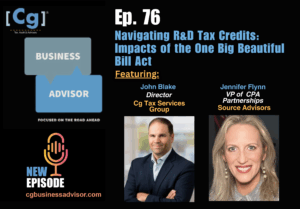 In a recent episode of the Cg Business Advisor Podcast, tax director John Blake, CPA, MBA, and R&D tax credit specialist Jennifer Flynn from Source Advisors broke down the important changes to Research and Development tax credits—and why businesses of all sizes should pay attention.
The Background: A Rocky Road for R&D Credits
The R&D tax credit has been around since 1981, originally created to keep research and development activity in the United States rather than seeing it outsourced overseas. The credit provides businesses with a reimbursement of approximately 7-10% of qualified research expenses, including employee wages, subcontractor costs, materials, and cloud computing expenses.
After being renewed 17 times (six of them retroactively), the credit finally became permanent in 2015 under the PATH Act. That legislation also introduced two major benefits:
- Allowed startups with under $5 million in gross receipts to use the credit against payroll taxes
- Permitted taxpayers to offset the Alternative Minimum Tax with the R&D credit
However, the 2017 Tax Cuts and Jobs Act created a significant challenge. While it lowered corporate tax rates (which actually increased the size of R&D credits), it also required businesses to amortize their R&D expenses starting in 2022. As Flynn explained, this change “really demotivated them to want to spend on R&D” and became “an innovation killer.”
What Changed in 2025?
The One Big Beautiful Bill, passed on July 4, 2025, reversed the amortization requirement for domestic research expenses. Effective after December 31, 2024, companies can once again expense their R&D costs in the current year.
Here’s what this means for different businesses:
For Small Companies (under $31 million in average gross receipts):
- Can amend returns for 2022, 2023, and 2024 to expense previously amortized R&D costs
- Alternatively, can take unamortized amounts over the next one or two years
For Larger Companies (over $31 million in receipts):
- Can only take unamortized R&D expenses over the next one or two years
- Cannot amend prior year returns
Important note: Foreign R&D expenses still require 15-year amortization.
More Industries Qualify Than You Think
Many business owners assume R&D credits only apply to pharmaceutical companies or high-tech startups. Flynn emphasized that it’s more about activities than industries:
- Software Development: Custom platforms, algorithm development, even enhancing off the shelf solutions
- Manufacturing: Improving processes, reducing waste, increasing energy efficiency
- Construction & Architecture: Sustainable design, meeting updated building codes, new modeling techniques
- Financial Services: Trading algorithms and technological platforms
- Publishers & Marketing: Interactive online tools and platforms
As Blake noted, even a digital imaging company that built internal software to track revenues and enhance order processing qualified for over $90,000 in credits across three years.
Real-World Impact
The podcast featured several compelling examples:
- A packaging materials manufacturer received $285,000 in federal credits and $22,000 in Pennsylvania state credits after stopping the credit in 2021 and going back to claim it
- A steel fabricator and erector obtained $130,000 for two years and expects another$80,000 in 2025
- These weren’t cutting–edge tech companies—just businesses trying to “keep the wheels on the wagon”
State Credits Add Even More Value
Beyond federal credits, most states offer additional R&D incentives. New Jersey, where Cg Tax Audit & Advisory is based, enacted its R&D credit in 1992 and decoupled from federal regulations in 2022. The state program particularly benefits emerging technology and biotechnology companies, which can sell unused credits to other businesses.
Don’t Leave Money on the Table
Both Blake and Flynn stressed that many businesses miss out on these credits simply because they don’t realize their everyday activities qualify. As Blake explained, “They don’t know that they don’t know—they just do their business and they don’t know they’re doing something that could save them a ton of money.”
The key is working with advisors who take a consultative approach and truly understand your business operations. Simple conversations about process improvements or internal software development can uncover significant tax savings.
Take Action
If you’re a business owner wondering whether you qualify for R&D credits—especially with the new changes allowing potential amendments of prior returns—now is the time to explore your options.
Contact the experts:
- John Blake, Cg Tax Audit & Advisory: jblake@cgteam.com | (732) 279-7711| cgteam.com
- Jennifer Flynn, Source Advisors: jennifer.flynn@sourceadvisors.com | sourceadvisors.com
Even if you’re not sure whether your activities qualify, a conversation costs nothing and could reveal substantial savings. With the ability to potentially amend three years of returns, the opportunity is too significant to ignore.
This blog post is based on Episode 76 of the CG Business Advisor Podcast. For more insights on tax planning and financial strategies, visit cgteam.com. To hear the full conversation, be sure to listen to this episode of The Cg Business Advisor wherever you get your podcasts: cgbusinessadvisor.com © 2025